Category - Energy

Good News! Drilling ANWR would save $0.02 per gallon, 10 years from now!

Saturday, May 24, 2008 by Tom Masterson
Categories: Energy, News

Just when you thought there would never be any good news about the economy, oil, or anything along comes this. McClatchey reports that a new report commissioned by Ted (”the internet is a series of tubes“) Stevens (R, Alaska) finds that drilling the Arctic National Wildlife Refuge in Alaska would, in ten years, bring the price of a barrel of oil down by $0.75. Wow. At today’s prices ($135 per barrel and $4 per gallon) that gives us a 2-cent reduction in prices at the pump. In ten years. Seems well worth it to me (in opposite-world; for fans of Superman, that’s Bizarro World [thanks Bob!]).

Is the Energy Bill Not-Insane?

Thursday, May 8, 2008 by Tom Masterson
Categories: Energy, Fiscal Policy, News, Politics, Taxes

J.S. at Environmental Economics seems to think so. Maybe. According to a NY Times piece the bill

would revoke $17 billion in tax breaks extended to big oil companies like Exxon Mobil Corp and slap a 25 percent windfall profits tax on firms that don’t invest in new energy sources.

My question is: will the Democrats grow a spine in time to pass such a bill, even in the face of some opposition?

Hidden taxes and even more hidden subsidies

Monday, March 24, 2008 by Jonathan Teller-Elsberg
Categories: Consumption, Energy, Environment, News, Taxes

BusinessWeek has a recent article about the new law requiring improvement in automobile and small truck fuel efficiency (”The Road to a Stronger CAFE Standard“). Among other things, the article describes how the law changes the way that the CAFE (Corporate Average Fuel Economy) measurement is calculated. Under the old CAFE calculation, fuel economy is measured separately for each auto manufacturer. Under the new calculation, all manufacturers will be measured together, and a trading scheme is established so that companies beneath the industry-wide average must buy credits from companies that are above the average. Since American auto manufacturers produce a disproportionate share of minivans, pickup trucks, and SUVs (all lumped together as “light trucks”), the American companies are more likely to be on the buyer side of the credit buying while companies like Toyota and Honda will be more likely to be on the seller side of the scheme. Says one guy from the American company perspective,

it’s SUV and pickup buyers who will be stuck with the tab, suggests Chrysler Vice-Chairman Tom LaSorda. “It’s likely to be another big hidden tax on the consumer, as well as small businesses and building trades.”

What BusinessWeek’s writer fails to mention is the other side of the equation: this system also results in a hidden subsidy for buyers of efficient cars. If Honda is selling lots of relatively efficient cars, and therefore is able to sell credits to Ford (which is selling more in the way of trucks), then Honda can hold down the price of the cars while still making the same overall profit. The pressure on Ford that pushes up the price of trucks will be an “equal and opposite” pressure on Honda to hold down the price of their small cars. All in all, it could be a completely neutral system in terms of the overall effect on consumers. Of course, lots of details and corporate decisions might end up making it either more or less than perfectly neutral in the end, but BW’s article is misleading when it only highlights the one side of the equation. On this general concept, see more about “feebate” proposals.

Oh, and by the way, all of Detroit’s (and Toyota’s, the Prius notwithstanding) hemming and hawing about how hard it is to make more fuel efficient is pretty obviously a load of bunk, even if the people doing the hemming and hawing believe their own bunk.

[Crosspost] Carbon labeling on my mind

Tuesday, March 11, 2008 by Jonathan Teller-Elsberg
Categories: Consumption, Energy, Environment, Globalization, News, Taxes

[Crossposted at my work blog.]

BusinessWeek’s GreenBiz blog tipped me off to a recent BW article on carbon labeling. Carbon labeling means to label consumer products with an indicator of how much greenhouse gas was emitted in the production and distribution of each product to the point of having it on the shelf in front of the customer. The idea has been around for a while, but only recently have manufacturers (like Timberland shoes) and retailers (like Tesco, a British chain of mega-grocery stores) started to implement carbon labeling programs. As it turns out, according to BW’s article, carbon labeling is tricky for a few reasons. First, it can be tremendously difficult to squeeze all the aspects of modern, globalized manufacturing into a single numerical measurement of greenhouse emissions. Second, for such programs to work, there needs to be a fair bit of consumer education so that people will have any idea of what these carbon labels actually mean. (If a label says, “50 grams of carbon,” is that good or bad or what?)

Here are some thoughts suggestions that probably have been thought of by other people as well, but what the hey:

1) The ideal carbon label will be structured similarly to the energy guide labels on refrigerators and other appliances we see in the US. That is, on a line that shows the minimum-to-maximum amount of greenhouse emissions caused by similar products to the one in your hand (like all canned vegetables or all pasta products or all color televisions) as well as an indication of where on this line the individual product falls. If canned vegetables incur anywhere between 10 and 100 grams of carbon-equivalent greenhouse emissions (using made up numbers for sake of the example), and the can in your hand incurred 30 grams, then you’d see something like “10—–30————–100″. That’s the first part of the labeling scheme, and would be called the “Manufacturing & Distribution” count. For some products, like canned vegetables, that would be enough. For products like TVs that require the ongoing consumption of energy in use, there would be another line (like the existing energy guide labels on refrigerators and such) that indicates the relative use of energy going forward, based on the average greenhouse emissions of the electric grid across the country. This would be the “Usage” count. Finally, for products that have both counts on their label would be a third measurement line called “Expected Lifetime” which would be a combination of the “Manufacturing & Distribution” count and an estimate of the probable cummulative lifetime “Usage” count, for example the combination of M&D plus 10 years worth of normal usage of a TV. Some products might have high M&D counts but be more efficient in use, and therefore their lifetime impact would be lower than an alternative product that had a lower M&D count but was inefficient in usage.

2) I realize that this notion of an ideal carbon label still ignores the difficulties in actually figuring out accurate counts for greenhouse emissions; but if you can get decent estimates of the emissions, then I think that’d be a good way to do the labeling in a way that consumers could interpret and make meaningful choices between products. You have to have the relative position of each product on a scale for the number to mean anything.

3) If you want to educate the populace on how to use these things, teach 10 year olds about it. They will quickly and insistently instruct the rest of us, treating us like absurd fools until such time as we master the system as well as they have.

4) The trickiness of figuring out accurate and consistent greenhouse emission labeling is an argument in favor of using carbon taxes/cap-and-trade systems. Sorta. On the one hand, the financial tool of carbon tax/cap-and-trade — implemented on upstream sources of carbon (and other greenhouse gases) — easily introduce an effective alternative to the carbon label into the economy. Product prices will rise relative to the amount of extra cost their manufacturers & distributors face as a result of the greenhouse gas emissions incurred during manufacturing and distribution. The can of corn that involved more greenhouse emissions will incur a greater carbon-cost increase than the alternative can of corn that involved less emissions. However, this isn’t totally satisfactory, because so much else is involved in pricing: the “price signal” is terribly noisy and prone to distortion and/or misinterpretation. In addition, there are some — how many? — people willing, even eager, to pay more for products that they are confident involve less greenhouse emissions. Working the greenhouse effect of a product into the product’s price is a good thing, but that doesn’t obviate the usefulness of a more fully informed consumer as a second level for reducing carbon footprints. One further thought on this, though: it’s possible that if a carbon tax is implemented, the tax itself could be used as a tool for measuring the greenhouse emissions on a product and therefore be the basis of the carbon label. Businesses already keep track of the taxes they pay, and so the added burden of accounting should be less than trying to account for a new system of purely physical carbon emission counting. Right? Because the carbon tax itself is predicated (or should be) on a carbon-equivalent scale, it would be an easy translation to take the cumulative taxes paid on a product through its manufacturing and distribution lifetime and restate that as an amount of carbon emitted during the process. The increasing use of rfid chips in distribution chains only makes this easier to implement, as you have better tracking going on and the ability to link movement of materials and goods to the taxes those materials and goods incur for the businesses making and moving them. (Having said this, I still favor a Peter Barnes’ style cap-auction-trade-dividend approach over the carbon tax approach.)

5) I gotta get back to work!

Too cool for words. Even YouTube barely does it justice.

Friday, February 15, 2008 by Jonathan Teller-Elsberg
Categories: Agriculture/Food, Economic Development, Energy, Environment, Gender, Globalization, Labor, News, Pop Culture, Social/Solidarity Economy

Peter Barnes’ new book: Climate Solutions

Friday, January 18, 2008 by Jonathan Teller-Elsberg
Categories: Commons, Energy, Environment, Inequality, News, Politics

My day job is as an assistant editor at Chelsea Green Publishing. I’ve been particularly excited about one book that we’ve been working on, Peter Barnes’ Climate Solutions: A Citizen’s Guide: What Works, What Doesn’t, and Why. Well, it’s just shipped from the printer, so now’s your chance to get a copy and check it out.

[update] I just came across a little BusinessWeek article focusing on Barnes’ ideas for a carbon dividend. They don’t get all the details quite right (all the more reason for you to read the book!) and they don’t mention the book (curses!), but “cap-and-dividend” just might be turning into a powerful and politically relevant meme.

BusinessWeek and Scientific American on the costs of addressing global warming

Saturday, January 12, 2008 by Jonathan Teller-Elsberg
Categories: Energy, Environment, News

BusinessWeek says it probably won’t be all that costly.

Scientific American has some dudes debate the issue.

And don’t forget my own brilliant observations.

MoveOn moves on climate bills

Wednesday, October 31, 2007 by Jonathan Teller-Elsberg
Categories: Commons, Energy, Environment, News

See the blog post I wrote for my employer’s website.

A friend of mine, who knows from my own previous email missives that there are important things afoot in Congress regarding pending legislation on global warming, forwarded me this message from MoveOn.org.

From: Ilyse Hogue, MoveOn.org Political Action
Sent: Tue, 30 Oct 2007 12:23 pm
Subject: Corporate windfall or clean energy economy

Click here to add your name: “Any climate legislation that gives ‘pollution credits’ away for free means windfall profits for big polluters. Congress should ensure that corporations pay taxpayers for these credits. The money raised should help develop clean energy sources and support the workers and consumers affected by the shift to clean energy.”

[cont’d]

A back-of-the-envelope sense of the socio-economic impact of reducing fossil fuel usage to fight global warming

Wednesday, October 24, 2007 by Jonathan Teller-Elsberg
Categories: Commons, Consumption, Energy, Environment, News

I’ve been writing posts recently advocating for a Sky Trust style program to
1) cap carbon emissions from the burning of fossil fuels
2) auction the permits within that cap
3) pay out revenue from the auction to each American on a per-person basis.

One thing I’ve wondered about is, “what will the impact be on people for reducing the availability of fossil fuels by the amount necessary to aggressively fight global warming?”

The first part of the answer is to see how much reduction of fossil fuels will be necessary. The standard goal being targeted in currently proposed legislation is to cut carbon emissions by 80% by the year 2050. That gives us roughly 40 years (since any program will only begin in a couple years at best), and, depending on the precise details of the program will require annual reductions–for the first bunch of years, at least–of between 2% and 4%.

“Little Green Lies”

Friday, October 19, 2007 by Jonathan Teller-Elsberg
Categories: Commons, Energy, Environment, News

From BusinessWeek:

Little Green Lies
The sweet notion that making a company environmentally friendly can be not just cost-effective but profitable is going up in smoke. Meet the man wielding the torch

Sobering thoughts from a dedicated environmentalist business-reformer. Among other things, what this shows is that real change in business behavior won’t come until the economics changes. The price of creating pollution must go up–when (if) it does, the return-on-investment equation will change, and that’s the best hope for changing business behavior and achieving real reductions in pollution. Ideally, this will take the form of a cap-and-trade program where all emission permits are auctioned and revenue recycled as per-capita payments to all Americans, as championed by Peter Barnes.

Climate policy cont’d: Obama talking the talk

Wednesday, October 10, 2007 by Jonathan Teller-Elsberg
Categories: Commons, Energy, Environment, News, Politics

Barack Obama must have read the Jonathan Alter article in Newsweek, or maybe he shared the back of a taxi with Peter Barnes. Whatever the cause for his conversion, he’s now speaking a bit of the gospel.

Presidential hopeful Barack Obama on Monday called for reducing U.S. greenhouse gas emissions by 80 percent of the 1990 level by 2050. His proposal would force power companies and other businesses to pay for all their pollution.

He proposed a modified “cap and trade” approach to reducing emissions that would require businesses to buy allowances to pollute, creating an incentive to reduce energy usage.

Under a traditional cap and trade system, power plants or businesses that exceed pollution caps must buy or trade for additional capacity, generally from plants that have taken steps to reduce their emissions. Unlike some of his rivals, Obama said he would auction all allowances rather than grandfathering some to big emitters such as oil and coal companies.

“No business will be allowed to emit any greenhouse gases for free,” he said. “Businesses don’t own the sky, the public does, and if we want them to stop polluting it, we have to put a price on all pollution.”

Sweetness. Of course, Obama is still listed as a co-sponsor of Lieberman’s “big business owns the sky, so give allowances for free to the big emitters” bill, so we’ll have to see what he does in terms of walking the walk. But for all my cynicism, hearing the right talk is an unexpected pleasure.

Meanwhile, I’m surprised to see this statement in the Washington Post “campaign 2008″ blog:

Most legislation offered to reduce carbon emissions takes this form [cap total emissions and allow trading of allowances within that limit], even though many economists believe a carbon tax would be simpler, if more difficult to sell politically.

Which “most” economists are they talking about? When you have a specific target you are trying to reach, taxes are a blunt and inaccurate instrument. Plenty of the nerdiest economists can whip up a quick model to show how a cap-and-trade system is more economically efficient (using the terms of market economics) than a tax system in this kind of scenario. Maybe someone needs to do a survey of economists or something. Anyhow, I badmouthed Congress the other day for being (or acting willfully) ignorant of simple economic principles.* But now, if the Washington Post is right, I’ve got to badmouth “most economists” and give credit to the politicians for getting this one right.

*”which is so Econ 101 it’s plain pathetic that most of Congress seems to be dismissing it out of hand

Climate bill followup: Sander’s bill better? Jury still out.

Monday, October 8, 2007 by Jonathan Teller-Elsberg
Categories: Commons, Energy, Environment, News

I’m in the process of playing catch-up with the climate legislation moving (or stalling, as the case may be) around Congress. I think I might have been wrong to identify Lieberman’s S.280 as the leading climate bill in the Senate. Turns out Bernie Sanders’ alternative bill, S.309, has close to twice as many co-sponsors (19 vs. Lieberman’s 11)–including Senators Clinton, Obama, Dodd, and Biden, a clean-sweep of the Senate’s presidential hopefuls. Oh wait–politics sure is messy–Clinton and Obama are also cosponsors of the Lieberman bill. Covering their bases, it seems. In Lieberman’s favor, his cosponsors include a bunch of Republicans, so while he has fewer cosponsors, that indication of “bipartisanship” might mean his bill would do better in a full Senate vote. Maybe so, maybe not.

I’ve only skimmed the Sanders’ bill so far, but frankly I’m finding it rather confusing. Well, maybe not confusing, but overly vague. (That’s something Lieberman’s has less of; it proudly wears the badge of corporate welfare on its sleeve.) The heart of it seems to be with Section 704 (f) (2), where it directs the EPA Administrator to establish a market-based program for reducing greenhouse gas emissions. The vagueness lies in the fact that the Administrator is not obligated–as far as I can tell–to use an auction for distributing the pollution permits (”emissions allowances”) to industry. This seems to leave open the possibility of a give-away. If that happens, then this bill will turn out to be not much better than Lieberman’s. While Section 704 (f) (2) (A) tells the Administrator to distribute any leftover permits to “households, communities, and other entities,” this is only an after-the-fact distribution. First industry gets a crack at the permits (through a give-away? an auction?), and only after that do households and communities get a chance to participate in the program. I’m sorry to say, that sounds like something paving the way towards a give-away.

Also, if I understand it correctly, Section 704 (f) (2) (D) grants the Administrator the ability to issue extra pollution permits (or by some other means to give relief to industry) if the cost of permits rises too high (according to the Administrator’s understanding of “too high”). That’s a dangerous loophole. Again, I find the law-speak a bit confusing, so the size of this loophole isn’t entirely clear to me. It does seem–thankfully–to be limited, because the Administrator is required to begin reducing the number of permits available after a maximum of three years of stalling the program. Still, all this vagueness and potential loopholiness has got me feeling more cautious than optimistic.

That’s it for now.

Lieberman climate bill: “worse than nothing”

Friday, October 5, 2007 by Jonathan Teller-Elsberg
Categories: Commons, Energy, Environment, News, Politics, Social/Solidarity Economy

The other night I attended a presentation by Peter Barnes at Vermont Law School. He was talking about different possible policies Congress might pursue to address global warming. Barnes is a persuasive advocate for a specific form of cap-and-trade on greenhouse gases, wherein the limited permits for emitting greenhouse gases are auctioned off and the revenue that comes in from the auction is then distributed on an equal per-person basis to everyone in the country. More on that in a moment (or see Jonathan Alter’s nail-on-the-head article in Newsweek).

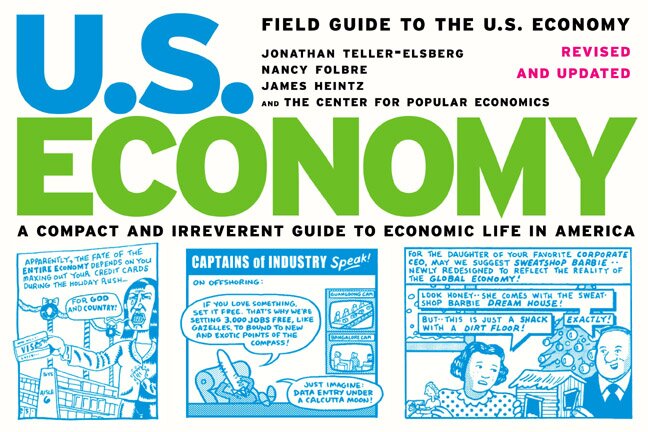
I’d heard about Barnes proposal before–in fact, Nancy Folbre, James Heintz, and I used it as the basis for a bit of the Field Guide to the US Economy. What I hadn’t realized was that there is currently legislation working its way through Congress that would implement a different variation of cap-and-trade on greenhouse gases. The leading version is Joe Lieberman’s S.280 in the Senate and the near-identical bill fostered by John Olver, H.R.620, in the House. (Part of my ignorance stems from the recent birth of my daughter Susannah. I haven’t been keeping up with the news very much.) (But she sure is cute!)

“Wow,” you might be thinking, “Congress might actually pass a bill that deals seriously with global warming. Will miracles never cease?” Well, um, don’t get too excited just yet.

Clotheslines

Friday, September 28, 2007 by Jonathan Teller-Elsberg
Categories: Class, Commons, Energy, Environment, News, Pop Culture

Jonathan Rowe at On the Commons is writing about clotheslines, and the “tragedy of the private” market that has made them illegal for millions of people. A useful reminder that–while no view is strictly objective–some absurdities are pretty easy to identify, and these are just as likely (more likely?) to derive from the unfettered association of individuals through the marketplace as from any other source, particularly when profit maximization is the mantra. (Because, in this case, it’s the hope that property values will rise as fast as possible that leads snobs to ban clotheslines from a neighborhood.)

Given that the Supreme Court has ruled that carbon dioxide should rightly be treated as a pollutant, but the EPA continues to fail to act, clotheslines in restricted neighborhoods might make a great form of civil disobedience. If you live in such a neighborhood, set up a clothesline and wait for the order to take it down. It’d make for a great story in the local paper, which would help to spread the word about this absurdity and, hopefully, lead to laws that overrule the we-prefer-to-pollute-the-atmosphere snob factor.

econospeak on carbon tax / permits

Saturday, September 15, 2007 by Jonathan Teller-Elsberg
Categories: Commons, Energy, Environment, News

Peter Dorman at Econospeak has a good conversation going on the advantages of controlling carbon emissions through auctioning off limited permits rather than using a tax on consumption of carbon fuels. Naturally, this reminds me of my implied plug for permits in my review of Peter Barnes’ Capitalism 3.0 [parts 1 and 2]. Regardless, Dorman is on the money when he concludes

Folks, this is a very important issue at a very important time. In the next year the contours of the national debate over climate change policy will be set. Huge ecological consequences – and gobs of cash – are on the line. It is essential to start off in the right direction. I’d like to see enough clarity and truculence in the activist community that journalists are forced to take notice.

Econ-Utopia: The Bloodless Revolution, part 1 of 2: A review of Peter Barnes’ CAPITALISM 3.0

Wednesday, June 20, 2007 by Center for Popular Economics
Categories: Books, Class, Commons, Econ-Atrocity / Econ-Utopia, Energy, Environment, Inequality, News, Political Economy, Politics, Social/Solidarity Economy

Jonathan Teller-Elsberg, CPE Staff Economist

A few weeks ago, CPE Staff Economist Jerry Friedman wrote an Econ-Atrocity reviewing Bill McKibben’s new book, Deep Economy. Though he says McKibben “has written a clear attack on much of what ails us,” Friedman nonetheless criticizes McKibben for approaching the environmental and social problems of the day from an individualist perspective. For all that McKibben wants to promote and revive “community,” he has the attitude (says Friedman) of a “personal Salvationist . . . [who thinks that] the enemy [is] ourselves: we use too much, waste too much, want too much; and the only salvation for the environment is to change our preferences, use less, recycle more, and choose to live simply.” What McKibben misunderstands or ignores, Friedman argues, is the power of social institutions to drive behavior, regardless of the desires and seemingly free choices of individuals.

I think that Friedman will find solace in Peter Barnes’ recent book, Capitalism 3.0: A Guide to Reclaiming the Commons, since Barnes’ approach is definitively institutional. The problem, according to Barnes, is that the structure of the economy and society leave too much power in the hands of corporate capitalism. Even if all the CEOs and boards of directors and politicians were replaced with kind-hearted souls like McKibben, we would still face pretty much the same issues of environmental decay, economic inequality, and other social ills—the logic of capitalism and the legal structure of private property rights force the leaders of corporations to do what they currently do. He learned this from personal experience as co-owner and manager of several business ventures, most famously Working Assets (a telephone and credit card company that donates one percent of gross revenues to progressive charitable organizations). “I’d tested the system for twenty years, pushing it toward multiple bottom lines [that consider social and environmental impacts in addition to profit concerns] as far as I possibly could. I’d dealt with executives and investors who truly cared about nature, employees, and communities. Yet in the end, I’d come to see that all these well-intentioned people, even as their numbers grew, couldn’t shake the larger system loose from its dominant bottom line of profit.” (Ironically, Bill McKibben is quoted on the front cover of Capitalism 3.0 helping to promote Barnes’ book.)

Wow. Supreme Court: “EPA can regulate carbon emissions”

Monday, April 2, 2007 by Jonathan Teller-Elsberg
Categories: Commons, Energy, Environment, News

What will happen? Maybe not much. What could happen? Something big.

Top Court: EPA Can Control Emissions

By MARK SHERMAN Associated Press Writer
© 2007 The Associated Press

WASHINGTON — The Supreme Court ordered the federal government on Monday to take a fresh look at regulating carbon dioxide emissions from cars, a rebuke to Bush administration policy on global warming.

In a 5-4 decision, the court said the Clean Air Act gives the Environmental Protection Agency the authority to regulate emissions of carbon dioxide and other greenhouse gases from cars.

Greenhouse gases are air pollutants under the landmark environmental law, Justice John Paul Stevens said in his majority opinion.

[cont’d]

And in quick response, words to the wise from the auto industry:

Automakers urge economy-wide approach to global warming
POSTED: 12:56 p.m. EDT, April 2, 2007

WASHINGTON (AP) — Automakers called for an economy-wide approach to global warming in reaction to a Supreme Court decision Monday that could give the government the authority to regulate the emissions of carbon dioxide and greenhouse gases from cars.

The Alliance of Automobile Manufacturers, an industry trade group representing General Motors Corp., Ford Motor Co., DaimlerChrysler AG, Toyota Motor Corp. and five others, said in a statement that “there needs to be a national, federal, economy-wide approach to addressing greenhouse gases.”

Of course, don’t expect things to work out all rosy…. The auto industry plans to be the first among equals at the negotiating table:

Dave McCurdy, the alliance’s president and chief executive, said automakers would work with lawmakers and federal agencies to help develop a national approach.

[cont’d]

But even still, the idea is right. Cap and trade? A carbon tax? Good old fashioned rationing? Banning the worst offenders (as in, no new fossil fuel powered electricity plants, followed by a phase-out of existing plants; mandatory efficient building materials and techniques; minimal acceptable auto fuel efficiency; etc)? There are lots of options for economy wide approaches to dealing with carbon pollution, and no time like the present to start trying them out.

Having said that, what the Supreme Court has ruled looks to be restricted to auto emissions (thus the auto industry’s insistence on economy-wide action, so they aren’t made the only ones to deal with the greenhouse gas problem). This is based on

§202(a)(1) of the Clean Air Act, which requires that the EPA“shall by regulation prescribe . . . standards applicable to the emission of any air pollutant from any class . . . of new motor vehicles . . . which in [the EPA Administrator’s] judgment cause[s], or contrib-ute[s] to, air pollution . . . reasonably . . . anticipated to endangerpublic health or welfare,” 42 U. S. C. §7521(a)(1).

Become an expert: read the Court’s actual decision in “Massachusetts et al v. Environmental Protection Agency et al.” [pdf]

P.S.–Don’t confuse this decision with the other environmental decision also released today, “Environmental Defense v. Duke Energy Corp.” That one rules that the EPA should be more rigorous in enforcing the Clean Air Act when power companies alter existing plants to ensure that no more pollution is released than before the alteration.

CO2 - expensive stuff

Thursday, March 15, 2007 by Jonathan Teller-Elsberg
Categories: Consumption, Economic Democracy, Energy, Environment, News, Political Economy

The CBC reports

Alberta carbon dioxide pipeline could cost $5B
Last Updated: Thursday, March 15, 2007 | 12:19 PM MT
CBC News

A plan to pipe carbon dioxide from Alberta’s oilsands and store it underground could cost as much as $5 billion, says Alberta’s environment minister.

The province wants to capture carbon dioxide and send it through a 400-kilometre pipeline. Intergovernmental Affairs Minister Guy Boutilier said earlier this month that the pipeline would cost $1.5 billion and the carbon dioxide would be used to help get more oil out of low-producing wells.

He was pushing for the federal government and industry to split the cost of the project.

But Environment Minister Rob Renner suggested Wednesday it could cost much more.

“The number of $1.5 billion has been floated,” Renner said. “I suspect that the number — all costs included — will be significantly higher than that.

“I’ve seen estimates as high as $5 billion by the time it has taken into account the cost to industry to implement the [carbon] capture facilities.”

[cont’d]

Wow. Just a thought here, and ignoring that the carbon dioxide would be sequestered (for how long and how securely?) in an effort to bring yet more fossil fuel to the surface so it can be burned and converted to carbon dioxide, most of which won’t be captured but will add to the greenhouse mix; so my thought is, just how much energy conservation technology could be implemented with $5 billion (even if it is Canadian dollars), or even the lower estimate of $1.5 billion? I’d definitely bet a dollar that it’d be enough to cancel out way more CO2 emissions than the pipeline would help sequester (and I repeat, for how long, and how securely?).

The Second Best Theory of Tortilla Prices

Monday, January 29, 2007 by Jonathan Teller-Elsberg
Categories: Agriculture/Food, Energy, Environment, Globalization, News, Trade

I don’t think that Tim Haab at Environmental Economics subscribes to the Econ-Atrocities, but by happy coincidence he’s written a blog post that would fit perfectly in the series. His topic is the Mexican government’s response to serious inflation in the cost of tortillas, which are a primary staple of the Mexican diet, and poor Mexicans (of which there are plenty) are getting hit by these price hikes like a punch to the gut. Should the Mexican government pursue a policy of price caps for tortialls? The “Theory of the Second Best” offers an interesting angle of analysis. I’ll let Tim explain it himself, but as a teaser here’s a bit of his conclusion:

If the price cap is a response to another inefficient policy, then the price cap may actually improve efficiency. The first best solution would be to remove the policies creating the inefficiently high corn prices. The second best solution might be to create a new policy to counteract the effects of bad policy. That’s the Theory of Second Best.

This all makes best sense as part of his full post, so go read it (it’s not long, so it won’t hurt).

Econ-Utopia: Greenbacks for Green Energy

Thursday, January 25, 2007 by Center for Popular Economics
Categories: Econ-Atrocity / Econ-Utopia, Energy, Environment, News, Politics

By Jonathan Teller-Elsberg, CPE Staff Economist

With Al Gore on Oprah giving his “inconvenient” PowerPoint presentation, new reports of melting ice sheets and rising sea levels, and the release of the British government’s Stern Review, which is the latest major estimate of the economic costs of climate change, the issue of global warming is becoming a part of mainstream politics and kitchen-table conversations. Since the burning of fossil fuels (oil, natural gas, and coal) is the main source of human-caused warming, the need for alternative forms of energy is clear.

Econ-Utopia: Environmental Tax Shifting

Wednesday, June 28, 2006 by Center for Popular Economics
Categories: Consumption, Econ-Atrocity / Econ-Utopia, Energy, Environment, News, Political Economy, Politics, Taxes, Unemployment

By Jonathan Teller-Elsberg, CPE Staff Economist

In the U.S., talk of tax reform usually means debates about taxes on income and wealth. A little less common are discussions of flat taxes and a shift from payroll, income, investment, or property taxes to consumption taxes—that is, a federal sales tax.

We’ve seen the miserable results of lowering taxes on the rich, and we’ll be dealing with the massive government debts for decades to come. Flat taxes are simply another way to lower taxes on the rich, under the guise of simplifying the tax system. (To be sure, simplifying taxes is not exactly something to dismiss out of hand—the system is far more intimidating than it should be.) The supposed advantage of a shift to consumption taxes is that the shift away from payroll and/or other taxes should lead to more jobs. This is because a payroll tax makes it “expensive” for a business to have an employee. If the payroll tax is reduced or eliminated, the business will have more money available to hire additional workers. The problem with consumption taxes is that they tend to be regressive—meaning that they fall hardest on lower-income members of society.

Another type of tax reform that deserves more attention is the environmental tax shift (ETS), also known as the green or ecological tax shift. The idea here is to increase taxes on activities that result in environmental damage and use the money generated to reduce other taxes by the same amount. As with the consumption tax idea, most proposals center around reducing payroll taxes.

Econ-Utopia: Food for Thought: How Buying Local Food Contributes to Sustainability

Wednesday, June 21, 2006 by Center for Popular Economics
Categories: Agriculture/Food, Consumption, Econ-Atrocity / Econ-Utopia, Energy, Environment, News

By Heidi Garrett-Peltier, CPE Staff Economist

In 1810, 84 percent of the U.S. workforce was employed in agriculture. Today, it’s down to two percent. Thanks to dramatic increases in productivity resulting from advances in technology and the mechanization of agriculture, we can produce a great deal more food with far fewer people than we could 200 years ago. But does this progress come at a cost?

Large-scale corporate farms are able to out-compete small-scale (often family-owned) farms and drive them out of business. Economies of scale (the competitive edge gained by being bigger) enable large corporate farms to produce more cheaply than smaller farms. These large farms are able to invest in expensive machinery and buy their inputs (fertilizer, seed, etc.) more cheaply than small farms, which in turn makes it difficult for small farms to compete. One might think that corporate farming is better for the consumer – large farms, producing more efficiently, can offer products at lower prices. In addition, the vast network of global agriculture allows consumers access to many varieties of foods throughout the year that can not be produced locally.

Econ-Atrocity {special History of Thought series} Small Is Beautiful: An Introduction to E. F. Schumacher

Thursday, February 5, 2004 by Center for Popular Economics
Categories: Econ-Atrocity / Econ-Utopia, Energy, Environment, Globalization, History of Thought, News

By Noah Enelow

Few economists of the last fifty years have offered more striking alternatives to mainstream economic thinking than Ernest Friedrich Schumacher. Born in Germany but spending the bulk of his working life in England, Schumacher’s career afforded him the ability to critique the economic system from within, and propose alternatives - not primarily through policy prescriptions, but through a radically different attitude towards life. He spent twenty years as the Chief Economic Advisor to the National Coal Board of Britain, and through that organization became intimately acquainted with problems of energy supply and environmental sustainability. Meanwhile, his interest in gardening, his study of Buddhist and Taoist thought, and his admiration for the work and philosophy of Gandhi led him to expand his economic thinking towards a wider set of values that he called “meta-economic.”

Several of Schumacher’s ideas are particularly relevant to contemporary economic life. Perhaps the foremost among these is the idea of decentralization. Schumacher’s idea of decentralization is more complex than simply breaking up a larger unit into smaller units. Rather, Schumacher proposed the idea of “smallness within bigness”; in other words, for a large organization to work it must behave like a related group of small organizations. In discussing economic development and poverty alleviation, this philosophy prescribes an orientation toward “regional” development strategies, which involve primarily local production for local use. In the era of globalization, this philosophy entails a radical rethinking of the orientation towards exports so often prescribed by international economic institutions.

Schumacher’s most radical break with the mainstream of economic thought, however, comes with his willingness to sacrifice economic growth - for so long the Holy Grail of economic policy and strategy - for a more fulfilling working life. Perhaps more than any economist since Karl Marx, Schumacher called attention to the quality of people’s lives as producers, even stressing its importance over their lives as consumers. Work, rather than being, as in neoclassical theory, a “disutility,” becomes in Schumacher’s philosophy a means towards satisfaction, fulfillment, and personal development.

In order to bring about these more fulfilling working lives, Schumacher proposes a radically different relationship between human beings and technology. The purpose of technology up until this point, he argues, has been to produce as much output per labor input as possible. The devices invented for this purpose, however, have not only served the dubious end of making many workers redundant, but their prohibitively high cost discourages self-employment. As a solution, Schumacher proposes an “intermediate technology,” one which can be easily purchased and used by poor people, and which can lead to greater productivity while minimizing social dislocation. Today, the Intermediate Technology Development Group works with agriculturists, food producers, small miners, and small manufacturers throughout the world to develop these tools.

Schumacher’s ideas have taken root in multiple forms and remain an ongoing and vital part of the discourse of economics. The E. F. Schumacher Society, in Great Barrington, Massachusetts, is the foremost center for the spread of Schumacher’s ideas in the United States. Founded in 1980 by a group of Schumacher’s friends and students, the Society contains a vast library of Schumacher’s works and a repository for communities currently putting his ideas into practice. The Society’s three top priorities are to stimulate the production of local currencies, to promote affordable access to and sustainable use of land through community land trusts, and to encourage and provide assistance to worker ownership and management of firms. Visit the website below to learn more.

Sources and Resources:

Schumacher, E. F. Small Is Beautiful: Economics As If People Mattered. New York: Harper and Row, 1973.

E. F. Schumacher Society. Special thanks go to Susan Witt, Executive Director of the E. F. Schumacher Society, for her assistance on this essay.

Intermediate Technology Development Group.

(c) 2004 Center for Popular Economics

Econ-Atrocities are a periodic publication of the Center for Popular Economics. They are the work of their authors and reflect their author’s opinions and analyses. CPE does not necessarily endorse any particular idea expressed in these articles.

Econ-Atrocity: Bolivia–The Battle Over Natural Gas

Wednesday, November 26, 2003 by Center for Popular Economics
Categories: Class, Econ-Atrocity / Econ-Utopia, Economic Development, Energy, Globalization, News, Race

By Noah Enelow

You would think the discovery of massive natural gas deposits in the heart of a developing country would present itself as an enormous windfall. All this country would have to do is find a source of financing, extract and refine the gas, sell part of it on the world market, and keep the rest, along with the profits, for domestic development.

Unfortunately, in Bolivia it hasn’t worked out quite so rosily. The battle over natural gas has exacerbated the country’s class and ethnic tensions to the point of warfare. Dozens of people have been killed in massive street protests; the president has resigned; the country is in chaos. What happened?

Upon first glance at the problem, there appear to be two root causes. The first issue was that the gas would have had to be exported through Chile, a longtime rival of Bolivia, which usurped Bolivia’s only seaport over a hundred years ago. The deal would thus enrich Chilean export companies at the expense of the Bolivians. The second issue was that the extraction and refining of the gas were to be undertaken entirely by a multinational company, Repsol-YPF. Their contract, signed long before the latest and largest gas deposits were discovered, was to provide the Bolivian public sector with 18% of the profits from sales. The rest would leave the country - a typical pattern for extractive industries in underdeveloped countries.

But those two issues are the just the tip of the iceberg. The peasants who make up the bulk of the protesters have good reason to believe they’d never see a dime of even those meager profits. Over the last two centuries, numerous raw materials have been extracted from Bolivia: silver, rubber, guano, and tin. The result? Underdevelopment, poverty, and disease. The leading cash crop of Bolivia, coca leaf, has been targeted for eradication by both the domestic government and the United States, as part of the “War on Drugs”.

Furthermore, as Bolivia has become increasingly beholden to the IMF’s structural adjustment program, life has steadily grown worse for the poor. In the last 3 years, the poorest 10% of the people have seen their incomes decline 15%, as the wealthiest 10% have seen their incomes increase 16%. Social services have been slashed while taxes have increased, to pay off the country’s high debt. How far can one expect a country to tighten its belt when its poverty rate is 70%?

Finally, the entire conflict is rife with ethnic and class tensions. The Bolivian elites are overwhelmingly of Spanish descent, while the poor are overwhelmingly indigenous. As a group, the former have proven untrustworthy, unaccountable, and corrupt; the latter grow more irate by the day.

The resignation of the U.S.-endorsed president, Gonzalo Sanchez de Lozada, who supported the gas plan, thus represents a victory for the poor. But the struggle is not over. The primary representative of the indigenous people, the self-described socialist and coca grower Evo Morales, in a recent speech declared the West a “culture of death”; meanwhile, in Sanchez’s resignation speech, he referred to Morales as a “narco-syndicalist” and warned of the power of the coca growers.

Is an agreement possible? A broad, highly organized coalition of labor and indigenous groups, the National Coalition in Defense of our Gas, has drawn up a list of demands. These include the formation of a constituent assembly to ensure greater popular participation in government, and the re-nationalization of Bolivia’s gas resources. The coalition has given the new president, Carlos Mesa, a 90-day truce to allow him to implement their demands. Will the two sides of Bolivia forge a new social contract, or will the country’s exports continue to enrich the few while leaving the many impoverished? Stay tuned.

References:

The Americas.org website contains a fantastic wealth of information about Bolivia. Numerous alternative sources and viewpoints are present alongside updates from the BBC and mainstream media.

Laura Carlsen. “Resources War: Lessons From Bolivia.”

Newton Garver, “Bolivia in Turmoil“, Counterpunch 10/17/03.

Keith Slack, “Poor Vs. Profit in Bolivian Revolt.”

(c) 2003 Center for Popular Economics

Econ-Atrocities are a periodic publication of the Center for Popular Economics. They are the work of their authors and reflect their author’s opinions and analyses. CPE does not necessarily endorse any particular idea expressed in these articles.